
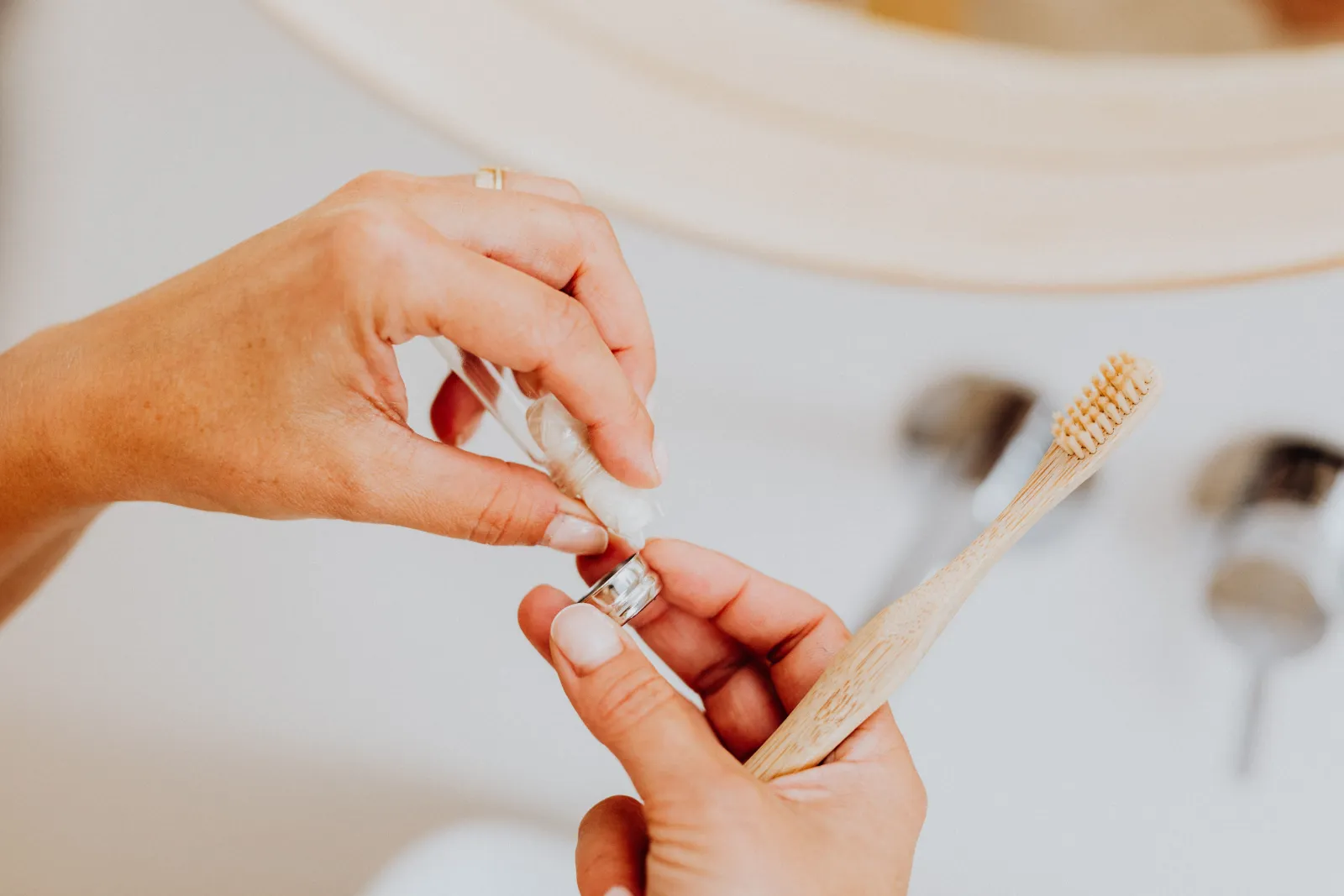
You've probably seen hydroxyapatite toothpaste on a store shelf or in an ad, sold as the fluoride-free choice. The pitch makes sense on its face, because it's the same mineral your enamel is made of. There's real research behind it, and some of the results are good, but there's less of it than the packaging suggests. Here's how it works on a tooth, what the trials compared it with, and who it suits.
What does hydroxyapatite toothpaste do to a tooth?
Your enamel is built from tiny crystals of a mineral called hydroxyapatite. When you eat or drink something sugary, the bacteria in plaque turn that sugar into acid. Strong enough acid pulls calcium and phosphate out of those crystals and leaves a weak, chalky patch on the surface. Between meals, saliva neutralizes the acid and slowly carries some of that mineral back into the tooth.
A cavity forms when the loss keeps outpacing the repair, week after week. Early on, the weak patch can still harden again if the balance tips back toward repair. Once the surface breaks down into a hole, the tooth can't rebuild it, and the fix becomes a filling.
Hydroxyapatite toothpaste carries very small particles of that same mineral, made in a lab. When you brush, some of those particles settle into the rough spots where acid has pulled mineral out. There they fill in tiny pores in the weakened surface. A 2021 review in the journal Odontology describes lab studies showing the particles depositing onto weakened enamel. The same review notes that Japan approved hydroxyapatite as an anticavity ingredient back in 1993.
Fluoride works a different way, and it adds no calcium or phosphate of its own. Instead, it helps the mineral already in your saliva go back into the tooth. It also turns that new mineral into a tougher version called fluorapatite, which holds up in stronger acid than ordinary enamel does. Our post on whether fluoride is bad for you walks through that step and the question of dose.
In short, hydroxyapatite brings its own mineral to a weak spot. Fluoride helps the mineral in your saliva go back in, and makes the repair tougher.
Is hydroxyapatite toothpaste as good as fluoride?
The first trial of its kind in adults, according to its authors, is an 18-month study published in 2023 in Frontiers in Public Health. It enrolled 194 adults aged 18 to 45. Half of them brushed with a fluoride-free toothpaste containing 10% hydroxyapatite. The other half used a standard fluoride toothpaste at a strength of 1,450 parts per million.
Of the 171 who finished as planned, 89.3% of the hydroxyapatite group had no new decayed, filled or missing tooth surfaces. In the fluoride group it was 87.4%. The researchers concluded that hydroxyapatite was "non-inferior," which means it was not worse than fluoride by more than a margin they had set in advance.
A 2024 review in the Journal of Dentistry pooled five clinical trials with eight studies run inside people's mouths. Its authors concluded that hydroxyapatite works against decay on its own, without fluoride.
So the short answer is that in the healthy young adults who were tested, hydroxyapatite toothpaste held up against fluoride toothpaste.
Where is the evidence thinner than the marketing?
Four details in those studies matter before you swap tubes.
Who was tested. The adult trial enrolled people with an average age of about 23. Each one needed at least ten back teeth with no decay, fillings or missing surfaces. The authors themselves describe the group as healthy, mostly young adults without significant oral health problems. The trial tells us very little about older adults or anyone who already gets cavities.
How "not worse" was defined. The researchers set a line in advance. Hydroxyapatite would count as not worse if the data ruled out a gap of 20 percentage points in fluoride's favor. In the end, the data ruled out any gap bigger than about 7 points. That leaves no room for a large disadvantage, but it doesn't prove the two toothpastes are equal.
Who paid. The adult trial was funded by Dr. Kurt Wolff GmbH, which sells Karex hydroxyapatite toothpaste, together with the two universities involved. Three of its authors work for the company. All six authors of the 2024 review were also authors on that trial. Two of the four authors of the 2021 review came from the company's research department.
How many trials exist. The review's pooled result rests on five clinical trials. Fluoride toothpaste has decades more behind it: a 2019 Cochrane review of fluoride toothpaste drew on 96 studies published between 1955 and 2014.
U.S. rules still treat fluoride as the only anticavity ingredient. The FDA's standard for over-the-counter anticavity toothpaste lists three active ingredients, and all three are forms of fluoride. The American Dental Association's Seal also requires fluoride for any toothpaste that carries a cavity protection claim.
Is nano-hydroxyapatite safe to brush with?
Some products use "nano" hydroxyapatite, meaning the particles are so small they're measured in nanometers, or billionths of a meter. The European Union's Scientific Committee on Consumer Safety reviewed this ingredient in 2023 and found rod-shaped nano particles safe at up to 10% in toothpaste. That opinion covers rod-shaped particles only, and the committee said it does not apply to needle-shaped ones.
Who does hydroxyapatite toothpaste make sense for?
The answer depends on how much acid your teeth face and how much protection they still have.
If your cavity risk is low and you'd rather skip fluoride, a fluoride-free hydroxyapatite toothpaste is a reasonable choice. Low risk means you brush twice a day and your checkups come back clean. The trial results fit you best, because people like you are the ones who were tested.
If your risk is higher, fluoride has the longer track record. Three situations raise the risk for adults.
Gums that have pulled back expose the root, which is softer than enamel and starts dissolving in milder acid.
A dry mouth, often caused by medicines, leaves less saliva to neutralize acid between meals.
Several fillings or crowns add edges where a restoration meets the natural tooth, and decay tends to start along those edges.
The adult trial wasn't designed to test any of these groups, and it turned away anyone whose medicines or health conditions reduce saliva.
Whichever tube you buy, toothpaste is only part of the job. It can help a weak spot firm up, but it can't fill a hole or clear hardened buildup at the gumline.
How do you know which group you're in?
Most of what decides your risk can't be felt, which is why it helps to see it. At your checkup, we take digital X-rays, do a full exam, and then go over the images with you on a screen. That's where early soft spots, exposed roots and decay starting at the edge of an old filling show up. At a professional cleaning, we remove the hardened buildup that no toothpaste can reach.
If you're thinking about switching toothpaste, ask us about it at your next visit. Call Steel Valley Smiles at (412) 462-3095 or use our contact page.
More from Our Blog
Does Teeth Whitening Damage Your Enamel?
Used as directed, whitening doesn't wear enamel away. Peroxide softens the surface for a short time, saliva repairs most of it within about two weeks, and the sting some people feel comes from the nerve.
Read more
Are Silver Fillings Safe, and Should You Replace Yours?
For most adults, a silver filling in good condition is safe to leave alone, and drilling it out costs healthy tooth. Dr. D'Alesio explains what the FDA said in 2020, who it named, and the signs a filling really needs replacing.
Read more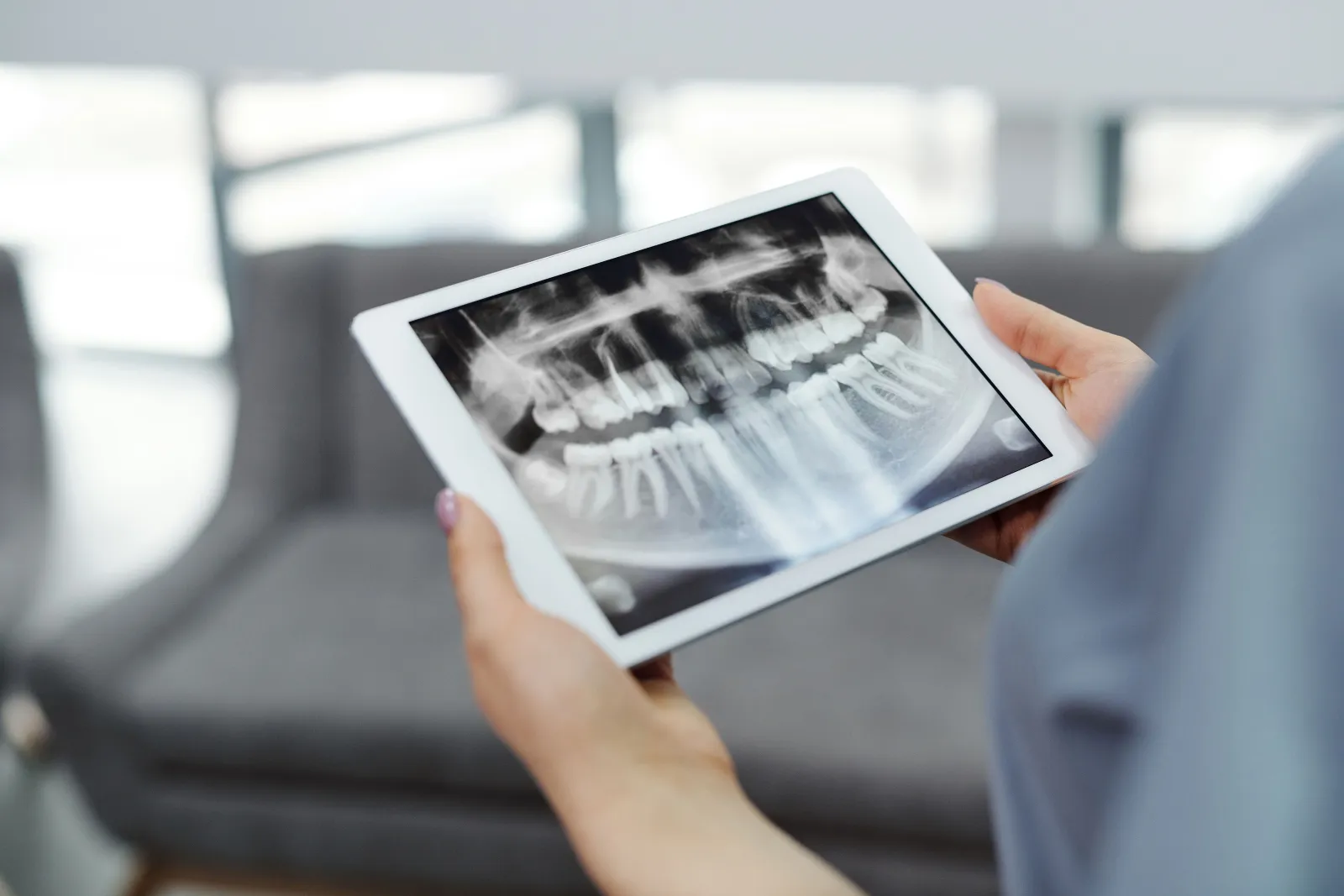
How Much Does a Root Canal Cost? What Changes the Price
Root canal cost follows the tooth: a back tooth has more canals to clean than a front one, and the crown that protects it afterward is a separate line. Dr. D'Alesio explains what a quote covers and what to ask for.
Read more