
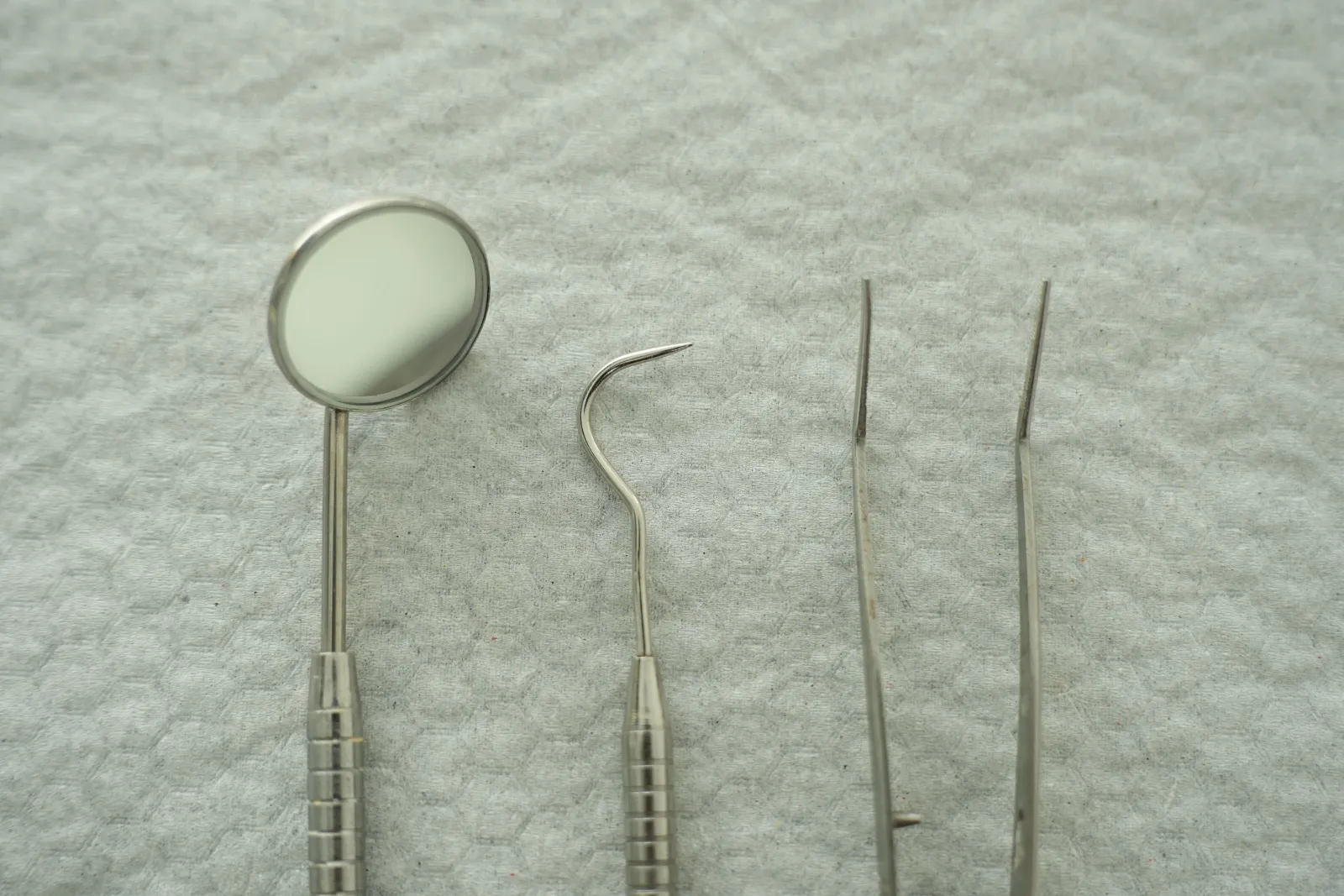
You ran your tongue over a tooth and it felt rough, or a cold drink stung for a second. Now you're wondering how you know if you have a cavity. Some signs you can notice yourself, but early cavities usually give none, and a common spot for one can't be seen in a mirror. Here's what you can feel, what only an exam and X-rays show, and why that gap matters.
How do you know if you have a cavity?
Some cavities do give signs. MedlinePlus lists tooth pain or an achy feeling after sweet, hot or cold food and drinks. It also lists visible pits, holes or dark spots on the tooth. Four things are worth noticing:
- A twinge from sweets, hot or cold
- A rough or chalky spot your tongue keeps finding
- Food that catches in the same place every time
- A visible hole or a dark spot that wasn't there before
The same MedlinePlus page opens with a different line: "There may be no symptoms." That line is the whole problem with a symptom list. A list can only describe cavities that have already got far enough to announce themselves.
Why doesn't an early cavity hurt?
The outer layer of a tooth is enamel, and it has no nerve in it. Plaque bacteria turn sugar into acid, and the acid dissolves minerals out of the enamel. The National Institute of Dental and Craniofacial Research says "in early tooth decay, there are not usually any symptoms."
Under the enamel sits dentin, which is softer and has tiny channels running toward the nerve in the middle of the tooth. Once decay reaches the dentin, sweet or cold can start to sting. Decay also spreads faster there, so a cavity is often wider underneath than the small spot on the surface.
The CDC puts the consequence plainly: cavities cause pain and sensitivity as they get bigger, especially when close to the nerve. The part of a tooth that hurts is the last part decay reaches. "Nothing hurts" tells you how far the problem has got, not whether you have one. And when pain does arrive, the cavity is usually deep, which means a larger repair than a small spot found early.
Why can a dentist find a cavity you can't see?
Think about where teeth touch. Each tooth presses against its neighbor at a small contact point, and decay often starts just below it. Your mirror can't see that spot, and neither can a dentist's eye, because the neighboring tooth is in the way.
That's the job of a bitewing X-ray. You bite down on a small tab, and the picture shows the sides of the upper and lower back teeth. The American Dental Association and FDA guidelines call for bitewings when the surfaces between teeth cannot be seen or probed. The ADA's MouthHealthy site says X-rays can reveal "new cavities" not visible during a dental exam. MedlinePlus agrees that X-rays may show some cavities before they can be seen by looking at the teeth.
At your checkup, we take digital X-rays, do a full mouth exam, then review the images with you in plain English on a chairside screen.
Is a dark groove on a back tooth always a cavity?
Not always, but you can't tell by looking. Chewing surfaces have deep pits and grooves that pick up stain from coffee, tea and food. NIDCR lists white, brown or black staining among the signs of decay, so a dark line can be stain or it can be a cavity.
A 2009 review in the Journal of Conservative Dentistry covers the ICDAS caries scoring system. Under that system, stains are recorded as sound tooth surface. So is a surface with multiple stained fissures, when the same is seen in other pits and fissures. The review also says a sharp explorer adds no accuracy and may damage the enamel over an early lesion. It describes a ball-ended explorer instead.
What a dentist checks is whether the spot has softened or broken through. NIDCR says dentists check the teeth for soft or sticky areas or take an X-ray. A photo can't tell you that, which is why we'd rather you call than diagnose a tooth from a picture.
Can an early cavity be reversed?
One early stage can, and it's a narrow one. NIDCR says a white spot where minerals have been lost is a sign of early decay. At that point "tooth decay can be stopped or reversed," because enamel can repair itself with minerals from saliva and fluoride from toothpaste. Once the surface breaks into a hole, the tooth can't rebuild it.
We've explained the mechanism twice already. Our post on whether fluoride is bad for you covers how fluoride helps enamel rebuild. The one on hydroxyapatite toothpaste covers what that mineral does and doesn't do. Neither one replaces an exam, because someone has to find the white spot while it is still one.
What is a filling for?
A filling doesn't cure the cavity, because decay can't regrow into healthy enamel. It removes the softened part of the tooth and rebuilds the shape, which seals the area so bacteria can't keep going. It also keeps the decay from reaching the nerve, where the fix can become a root canal.
We place tooth-colored composite fillings. For the steps and what to expect, see composite fillings or our guide to composite fillings in Munhall.
Cleaning between your teeth every day helps protect the contact points, as our post on whether flossing is necessary explains. A professional cleaning takes off the plaque and tartar that home care leaves behind.
If you've noticed a rough spot, a twinge or food catching in one place, call us at (412) 462-3095 or use our contact page. If nothing hurts, call anyway, because early is when a cavity is smallest and simplest to fix.
More from Our Blog
Crown or Filling Fell Out? What to Do, Temporary or Permanent
Keep the crown, clean it, cover the tooth and chew on the other side, then call the office. A temporary crown comes off easily by design. A final crown or filling that comes off can mean decay or damage underneath.
Read more
Dental Insurance Annual Maximum: What Happens to Unused Benefits at Year End
Your annual maximum is a ceiling on what the plan pays in one benefit year, and it starts over when the year ends. Here is how it works, what to ask your plan, and how a treatment plan can split across two years.
Read more
Dental Implant or Bridge? What Each One Does to the Teeth Around It
A bridge hangs the new tooth from the two teeth beside the gap. An implant replaces the root and leaves them alone. Here is what that means for your teeth and your bone.
Read more