
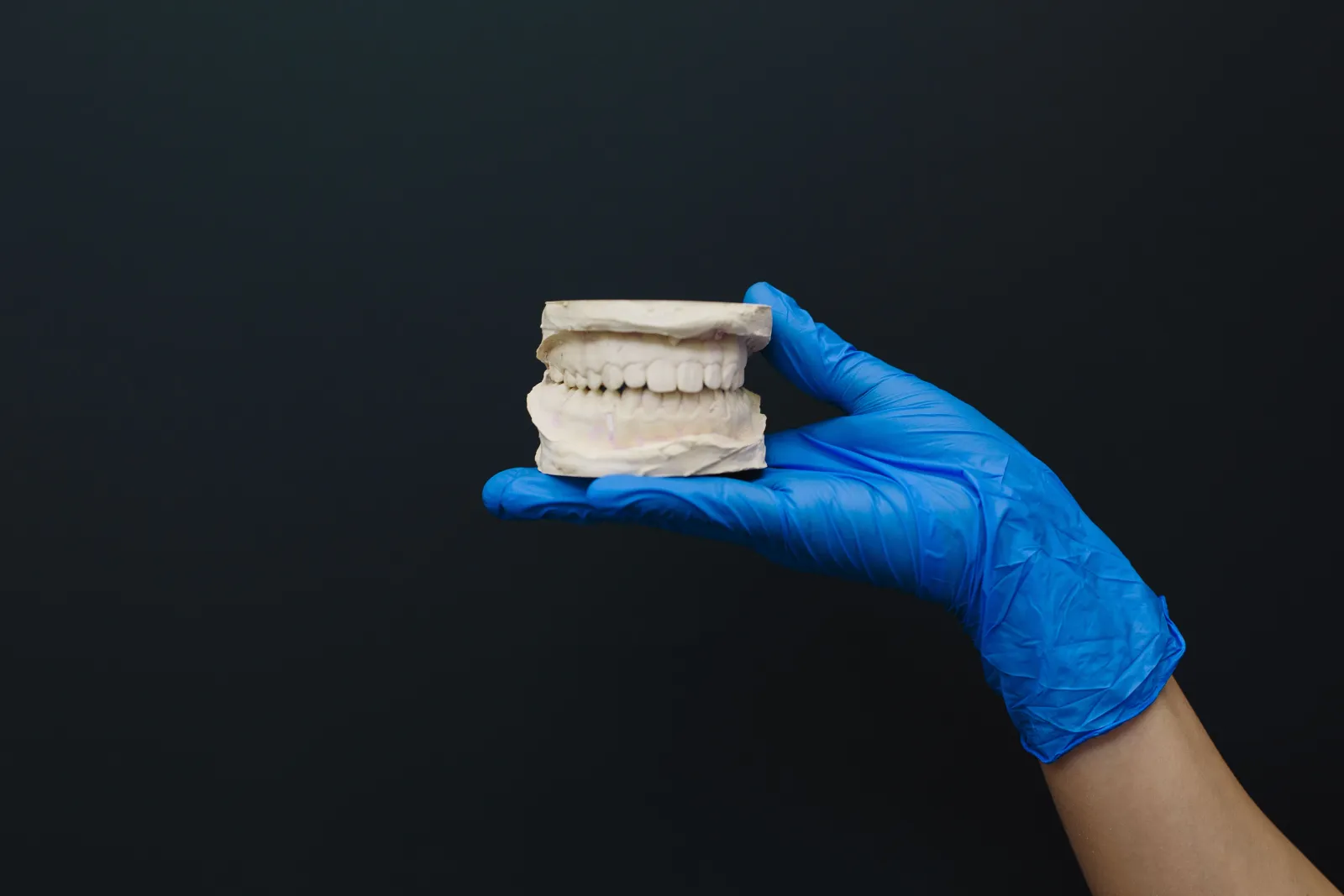
Maybe you bit into something chewy, felt a small click, and your tongue found a hollow where a smooth tooth used to be. If your temporary crown fell off, or a crown or filling came out, keep the piece, chew on the other side, and call the office. Whether it is routine or urgent depends on why it came off, so that comes first.
Why did my temporary crown fall off?
A temporary crown is meant to come off. We shape the tooth at the first visit and cover it with a temporary while an outside lab makes the final crown. The temporary is held on with a weak cement, on purpose. A dental trade report says a temporary cement's retention should be low enough to allow the restoration to be removed without damaging the tooth. We have to take that temporary off when the lab crown arrives, and a strong cement could chip the tooth we just shaped.
The same report quotes a dentist on a common cause of early loss. Biting on the temporary hard, again and again, can dislodge it. So a temporary that comes off is usually routine, but it still needs attention soon.
What should I do if my temporary crown fell off?
- Keep the crown somewhere safe and bring it with you.
- Call us, and we'll tell you how soon to come in.
- Brush around the tooth gently with fluoride toothpaste, as the NHS Wales advice on lost fillings and crowns says.
- Chew on the other side, and skip hard foods and very hot or cold food and drink. NHS Wales also suggests keeping sugary food and drink to mealtimes.
We shape the tooth for the crown at the prep visit. Without its temporary, it can be sensitive to very hot and very cold food and drink, which is why NHS Wales says to avoid them.
Why did my final crown or filling come out?
A crown or filling that held for years came out for a reason. A dentist-reviewed Healthline article on lost crowns names the main ones.
The cement wore down. Healthline says bacteria can creep under a crown and cause decay. That is likelier when some of the cement gets worn or washed away. Grinding your teeth is on its list of causes too.
Decay got under the edge. If bacteria find a gap at the edge, they eat away the tooth the crown was gripping. The crown loses its hold because the tooth under it has changed shape.
There wasn't much tooth left, or the tooth is fractured. Healthline lists too little tooth structure as a cause. It says a fractured tooth may need a new crown after the tooth is prepared again.
You can't tell which one it was from a mirror. That's what an exam and an X-ray are for.
What can I put on the tooth until I'm seen?
Home advice for a lost crown is the same in most places. Keep it, keep the tooth clean, protect it from hard food and call the dentist. Some pharmacies also sell a temporary crown cement kit.
A Health Education England pharmacy fact sheet, written for the UK, says a stable crown can be re-cemented with a temporary cement kit. It can also be sealed with a temporary filling kit. The sheet calls that the least preferable option, because a dental assessment is the best choice in all cases. Healthline describes a temporary cement as optional, and only after cleaning the inside of the crown. Either way, the crown still needs us to look at it.
For sensitivity, NHS Wales suggests a sensitive toothpaste rubbed on the tooth with your finger.
What happens if I wait to get it fixed?
Without the crown or filling, the part of the tooth it covered is open to food and bacteria. The same fact sheet lists the risk as pain, swelling and infection, and says to arrange a dental assessment as soon as possible. NHS Wales lists a new filling, a crown or root canal therapy among the treatments a dentist may offer. Which one fits depends on what the exam finds.
Which signs mean I should call the dentist today?
Call us the same day, and say so on the phone, if you have any of these. Sharp pain that doesn't settle, a bad taste, or a swollen face or jaw. The NHS lists all three among the signs of a tooth abscess, which our abscess post explains. The pharmacy sheet also asks whether the tooth has broken inside the crown, so tell us if it looks that way. Our post on a chipped or broken tooth covers how deep a break can go.
Go to an emergency room, or call 911, if swelling makes it hard to breathe, speak, swallow or open your mouth.
What if it comes out when the office is closed?
We're open Monday through Thursday, 8:00 AM to 4:30 PM, and closed Friday through Sunday. Call us first at (412) 462-3095. When you call during those hours, we do our best to see urgent patients the same day, so earlier in the day is better. Our emergency visits page and our post on emergency dental care in Munhall cover the rest.
If it happens on a Friday evening or over a weekend, keep the piece, keep the tooth clean, and call when we open. If you have severe pain or swelling, don't wait for us. An urgent care or emergency room is the place to go.
What happens at the visit?
We look at the crown and the tooth, and an X-ray can show what's under the edge. What we find decides the plan, and we can't promise in advance that a crown goes back on the same day.
If the tooth is sound and the crown is stable, it can be cleaned and cemented back. If there's decay under the edge, it has to be removed first, and the old crown may no longer fit what's left. When enough tooth remains, it can get a new crown, which is kind of like a hard hat for a tooth.
A new crown follows the usual steps of a scan, a temporary, a lab and a fitting visit. Our post on crowns and bridges walks through them.
A lost filling can be rebuilt with a tooth-colored composite filling when enough tooth is left. A larger break may need a crown instead. If a crack or an exposed nerve is the cause, we go through the options with you.
Ready to have it looked at?
Call us at (412) 462-3095 and tell us which piece came off and how the tooth feels, or use the contact page. Bring the crown with you in a clean container.
More from Our Blog

Dental Insurance Annual Maximum: What Happens to Unused Benefits at Year End
Your annual maximum is a ceiling on what the plan pays in one benefit year, and it starts over when the year ends. Here is how it works, what to ask your plan, and how a treatment plan can split across two years.
Read more
Dental Implant or Bridge? What Each One Does to the Teeth Around It
A bridge hangs the new tooth from the two teeth beside the gap. An implant replaces the root and leaves them alone. Here is what that means for your teeth and your bone.
Read more
Is Flossing Actually Necessary? What the Evidence Shows
Yes, you need to clean between your teeth every day, because a toothbrush can't reach the spot where gum disease and hidden cavities start. Floss is one way to do it, and interdental brushes are another.
Read more