
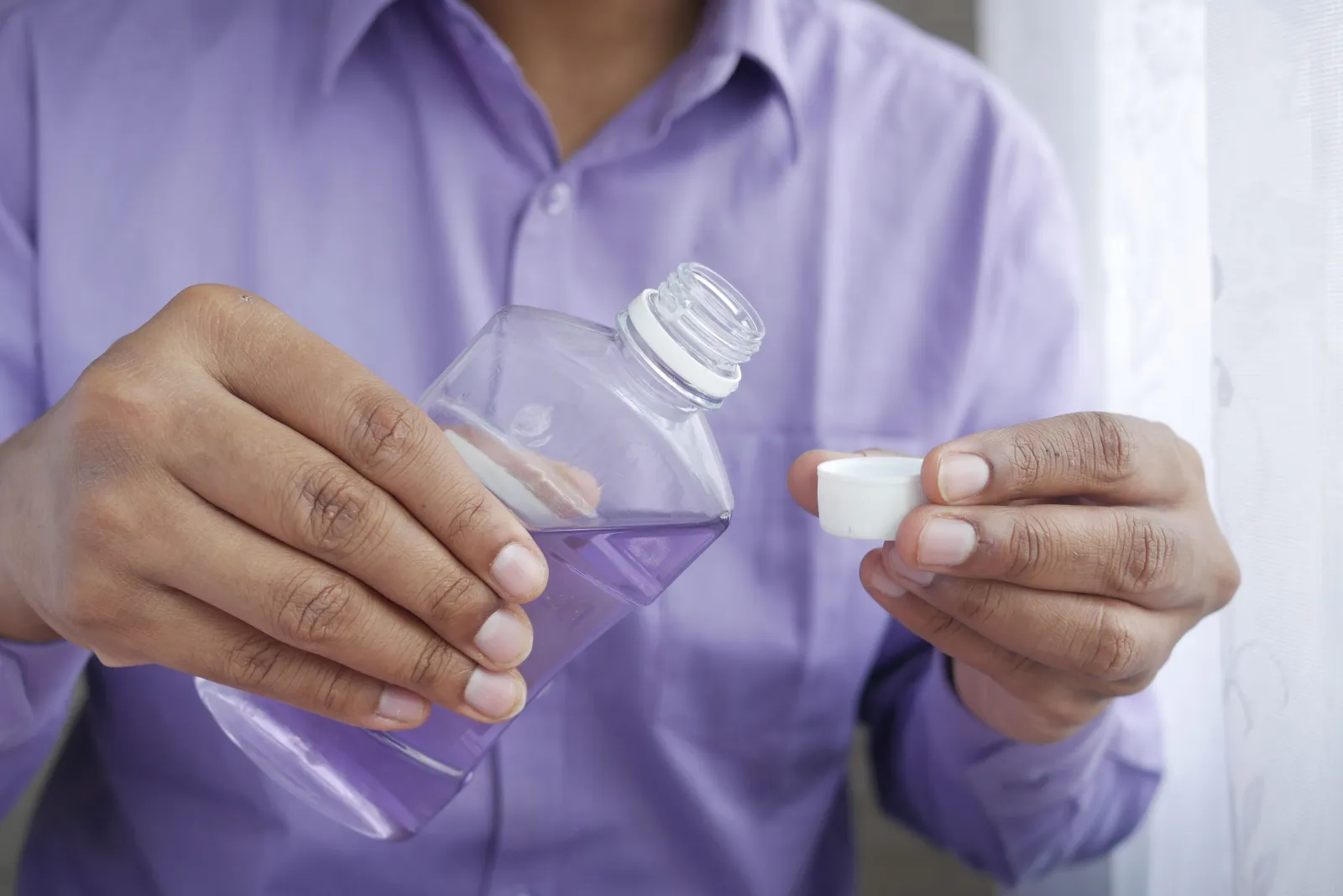
You swish, it burns, and the label promises to kill nearly every germ in your mouth. Then you read a headline saying mouthwash raises your blood pressure or wipes out your good bacteria, and you start to wonder. So is mouthwash bad for you? For most people, no, but "mouthwash" covers three very different products, and the worries people raise apply to some of them and not others. The bigger problem is a quieter one: a rinse can't do the job a cleaning does.
Is mouthwash bad for you, or is it the wrong kind for the job?
The American Dental Association sorts rinses into two groups. Cosmetic rinses freshen your breath and leave a pleasant taste, and that's all they do. Therapeutic rinses carry an active ingredient aimed at plaque, gingivitis, cavities or bad breath, and they split into two different jobs.
- Cosmetic rinses mask odor for a while, but they don't lower your risk of cavities or gum disease.
- Fluoride rinses strengthen enamel by helping the tooth rebuild the minerals that acids pull out of it after you eat.
- Antibacterial rinses go after the bacteria in plaque, using essential oils, cetylpyridinium chloride (CPC) or chlorhexidine, which is prescription only.
A Cochrane review of 37 trials with 15,813 children and teenagers found 27% fewer decayed, missing or filled tooth surfaces with a fluoride rinse. The authors judged that the benefit is likely to hold even alongside fluoride toothpaste. For antibacterial rinses, the ADA notes that chlorhexidine and essential oils both help control plaque and gingivitis. Most of the scary headlines are about this third group, and our post on whether fluoride is bad for you covers the second.
What can a rinse reach, and what can't it?
Plaque isn't loose food, it's a colony of bacteria glued to the tooth inside a sticky film they make themselves. An antibacterial rinse kills some of the bacteria on the outer surface of that film, but it doesn't peel the film off. A toothbrush and floss do that, because they physically scrape it away.
Plaque left in place hardens into tartar as minerals from your saliva settle into it. Tartar bonds to the tooth so firmly that no rinse dissolves it, and only an instrument removes it. That's why scaling is the first step of every professional cleaning we do, followed by polishing, flossing and a final check.
The other limit is depth: when gums become inflamed, they pull away from the tooth and leave a pocket. Swished liquid washes over the pocket's opening but doesn't reach the bottom, where the bacteria doing the damage sit against the root. That's how a rinse can make a mouth with gum disease smell better while the disease underneath keeps going. The ADA puts it plainly: a rinse doesn't take the place of brushing and flossing. Our post on oil pulling covers the same limit.
Does the alcohol in mouthwash cause problems?
Alcohol is what makes some rinses burn. For people whose mouths already run dry, the ADA advises avoiding alcohol, including alcohol-containing rinses, and suggests alcohol-free rinses instead. Saliva washes away food and neutralizes acid, so a drier mouth leaves teeth sitting in acid for longer.
On oral cancer, a 2023 review in Revista de Saúde Pública pooled studies covering 6,515 people with the disease and 17,037 without it. Overall, mouthwash use showed no link to oral cancer, and neither did alcohol-containing rinses on their own. The caveat is heavy use: people who rinsed three or more times a day had a higher risk. Only two studies measured that, and the authors urged caution. If you find yourself rinsing that often, it's worth asking why, and the last section of this post comes back to that.
Does mouthwash kill the good bacteria too?
Yes, because an antibacterial rinse doesn't choose which bacteria it reaches. Some of them do useful work. Bacteria on the back of your tongue turn nitrate from foods like leafy greens and beets into nitrite. Your body then turns nitrite into nitric oxide, which helps blood vessels relax. Kill enough of those bacteria and, in theory, blood pressure could creep up.
Researchers have tested that theory, and the results are mixed. A 2026 review in BMC Cardiovascular Disorders found nine studies, and five showed a rise in blood pressure while four showed none. Where a rise was measured, it was small, about two points on the top number. Three of the five studies that found a rise used prescription chlorhexidine, and one also found it with a CPC rinse. An essential-oil rinse showed no significant effect, and the authors wrote that no firm conclusions can be drawn yet.
One study in that review followed 540 overweight adults in Puerto Rico for about three years. People who used mouthwash twice a day or more developed high blood pressure at a higher rate than people who rinsed less often. A study like that shows a link, not a cause. Still, it fits the cancer findings: an antibacterial rinse is a tool for a reason, not an all-day habit.
Antibacterial rinses have one more side effect worth knowing about. The ADA notes that chlorhexidine and CPC can leave brown stains on teeth, the tongue and fillings. Surface stain like that is what the polishing step of a cleaning is for.
Which mouthwash should you use?
Start with what you want the rinse to do, then pick the type that does that job.
- Fresher breath before a meeting: a cosmetic rinse is fine, as long as you know it's masking odor rather than cleaning.
- Fewer cavities: a fluoride rinse, used at a different time from brushing, such as after lunch. The NHS explains that rinsing straight after brushing washes away the fluoride your toothpaste left behind.
- Plaque and bleeding gums: an antibacterial rinse used as directed, alongside brushing and flossing rather than in place of them.
- Dry mouth or a burning feeling: an alcohol-free version of whichever type you need.
Whichever you choose, look for the ADA Seal of Acceptance. The ADA says the Seal means the company showed the product is safe and does what it claims. The ADA also says young children shouldn't use mouthwash, because they may swallow it.
When is reaching for mouthwash a sign of something else?
If you rinse because your breath never stays fresh, or because you taste blood after brushing, the rinse is covering a signal. Bad breath that keeps coming back and gums that bleed are two of the earliest signs of gum disease. A rinse can quiet both while the pocket underneath gets deeper.
At a gum health visit, we measure the depth of the pockets between your gums and teeth. If tartar has built up below the gumline, the usual treatment is a deep cleaning, called scaling and root planing. We numb the area with local anesthetic and clean the root surfaces, usually over one or two appointments. After that, maintenance visits every three to four months help keep those pockets in check. Our post on whether gum disease can be reversed explains where the line falls.
If you're not sure which rinse fits your mouth, bring the bottle to your next cleaning and ask. Call us at (412) 462-3095 or reach us through our contact page.
More from Our Blog

Oil Pulling: Does Swishing Coconut Oil Clean Your Teeth?
Oil pulling is unlikely to hurt as an extra, but it can't replace brushing, flossing or a professional cleaning. Dr. D'Alesio explains why plaque has to be scrubbed off and what the studies actually found.
Read more
Signs Your Dental Implant Is Infected, and What Happens Next
An infected implant can bleed and swell at the gum without hurting at all. Here are the signs, why implants feel so little, and what happens once we find it.
Read more
Is Sparkling Water Bad for Your Teeth?
Plain sparkling water does very little to enamel. Added citric acid, added sugar and all-day sipping do far more than the bubbles. Dr. D'Alesio explains what the studies measured.
Read more