
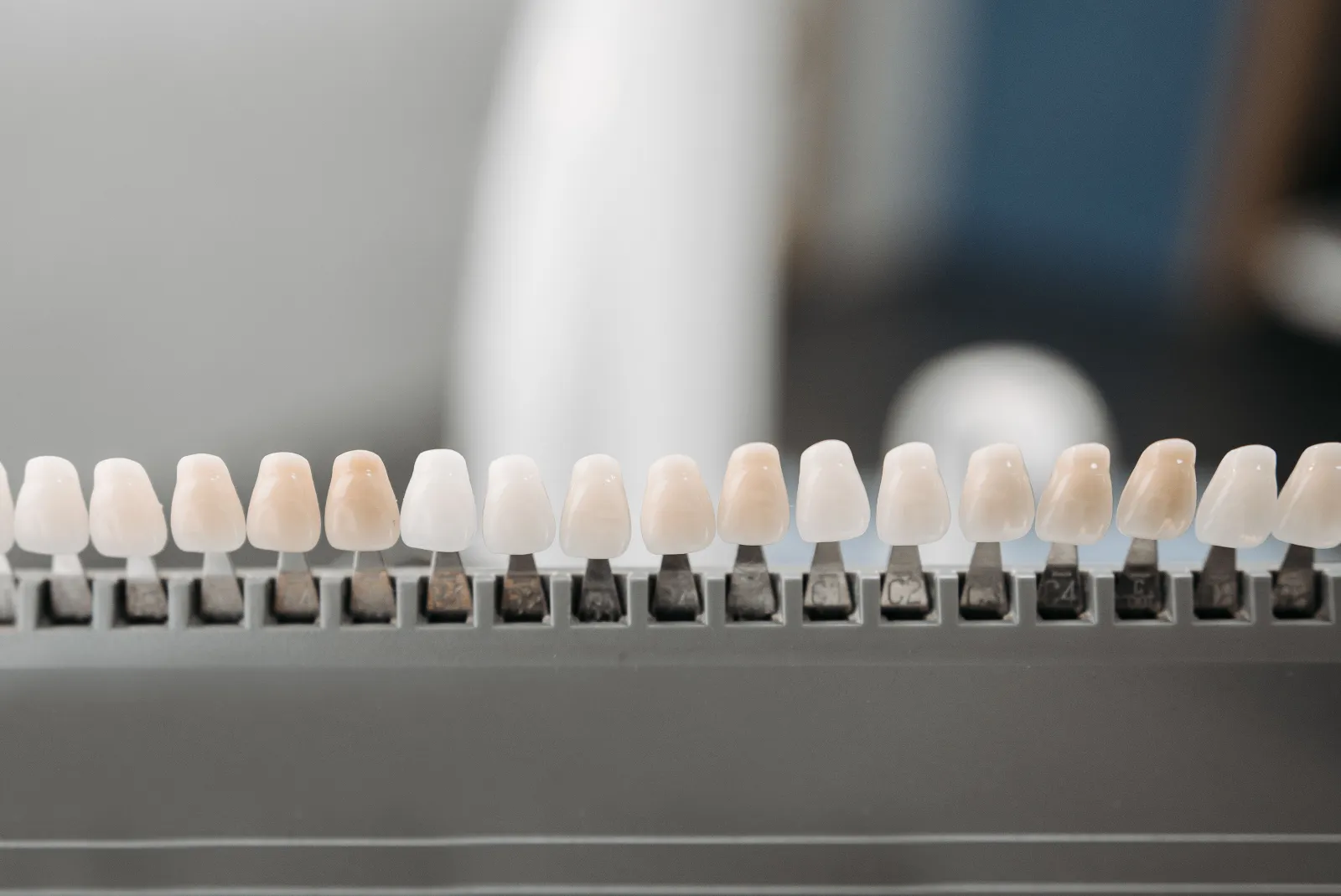
If you've searched for the average cost of veneers, you've likely seen a price per tooth and a far bigger one for a full set. A veneer quote is built one tooth at a time. Three things move it: how many teeth, which material, and what has to happen before anything is bonded.
Why is the average cost of veneers quoted per tooth?
A veneer is a thin tooth-colored shell bonded to the front of one tooth. Each one is shaped and shaded for the tooth it covers, so each one is its own piece of work.
Billing follows the same logic. The procedure codes dentists use, published by the American Dental Association and listed in this UnitedHealthcare dental policy, describe a single veneer. They come in three kinds: resin built directly on the tooth, resin made outside the mouth, and porcelain made outside the mouth.
So a per-tooth figure on its own can't tell you what you'll pay. To get anywhere close to your own total, you need to know how many teeth are involved.
How many veneers does a smile usually need?
Stand at a mirror, give your widest smile, and count the upper teeth you can see from one side to the other.
A 1984 study of 454 photos of smiling dental and hygiene students found the average smile showed the six upper front teeth and the premolars. Premolars are the teeth just behind the pointed canines, so that's more than six teeth. Your own count may differ, which is why the mirror is worth a minute.
That count matters because veneers change color and shape. If you veneer only the four front teeth and your smile shows ten, the teeth at each end keep their old shade and outline. They can end up looking like they belong to someone else. So a plan to change a whole smile follows the teeth your smile shows, while a single chipped tooth may need just one veneer.
What does a porcelain veneer's price pay for?
Porcelain veneers here go through three stages, starting with a design consultation. At the prep visit, we numb the area, remove a thin layer of enamel from the front of each tooth, and place temporaries. The final set is made at an outside dental lab, and at the last visit we fit and bond each one.
The lab is a real part of the cost, because a technician makes each shell for the one tooth it will cover. The porcelain is shaded so it lets light through the way enamel does. That work happens once for every tooth, so it adds up tooth by tooth too.
The enamel step matters for the long run, not only the first bill. Enamel doesn't grow back, so a tooth prepared for porcelain will need a veneer or another covering from then on. If a veneer is replaced years later, that's a new lab piece and a new bill.
Porcelain or composite: which costs less over time?
Composite is a tooth-colored resin. At our office it's done as composite bonding, built onto the tooth in one appointment, with no lab and usually no drilling or numbing. No lab fee and a single visit are why it costs less up front.
The tradeoff shows up later. Resin is softer than porcelain, so it wears, dulls and picks up stain sooner. A 10-year Brazilian study of 1,459 veneers placed in one private practice compared the two, using its records, not a trial. Counting any repair, composite veneers needed work at about 10% a year, against about 3% for porcelain. Counting only those lost or replaced, the rates were about 4% and 1% a year.
For porcelain on its own, a 2021 review pooling 25 studies and 6,500 veneers estimated that 95.5% had not failed at 10 years. Breaks were the most common problem, then veneers coming loose, mostly in the first years.
Put together, composite asks less of your tooth and your budget at the start, and more upkeep after that. How long tooth bonding lasts covers what wears it down and when it can be patched. The two sit side by side in bonding vs. veneers.
What else can change a veneer quote?
Work that has to come first. A veneer bonds best to a healthy tooth in healthy gums. The same UnitedHealthcare policy lists active gum disease, extensive decay and grinding as reasons veneers aren't a good fit. If you need a filling or gum care first, that's its own part of the plan.
Grinding changes the plan too. It puts heavy force on the thin edge of each veneer, so tell us if you grind or clench. It's part of deciding whether veneers suit your bite.
Whitening, if you want lighter teeth. The American Dental Association notes that only natural teeth whiten, not tooth-colored restorations. If you'd like your other teeth lighter, they're whitened first, and the veneers are matched to the new shade. There's more on that order in what teeth whitening costs.
Insurance. The UnitedHealthcare policy says veneers are "typically used for cosmetic purposes," and lists certain fractures and enamel defects, not looks, as reasons for them. Other plans set their own rules. We're not under contract with every company, and that changes the billing, not whether we can see you. Call us and we'll check your plan.
Why should the design come before the price?
A fair quote needs two answers: how many teeth, and which material. Both come out of the design, because the design shows how far each tooth has to change in shape, length and shade.
Porcelain veneer cases here start with Digital Smile Design. We photograph your smile and study your facial proportions, take a 3D scan, and build the design on screen. You see a digital preview and approve it before treatment starts. Once that preview is settled, the tooth count and the material stop being guesses. There's more on how the whole process runs in dental veneers in Munhall.
What should you ask for in a veneer quote?
- The number of teeth and the material for each, with the price per tooth and the total in writing
- Whether the design visit, temporaries, lab fee and final bonding are all included
- Any work needed first, such as fillings, gum care or whitening, listed on its own
- What a repair or a replacement would involve later
- How your bite and any grinding were taken into account
If spreading the cost helps, we work with CareCredit and Cherry, and both are explained on our financing page.
If you're weighing veneers, call us at (412) 462-3095 or use our contact page to set up a design consultation.
More from Our Blog

Chipped or Broken Tooth: What to Do in the First Few Hours
Call the office, keep the broken piece in water, cover the sharp edge and hold something cold on your cheek. How deep the break goes decides how urgent it is and how it gets repaired.
Read more
Is Fluoride Bad for You? What the Research Says
At the level set for U.S. tap water, fluoride helps enamel resist acid. The 2024 federal review on fluoride and IQ linked lower scores to levels more than twice that. Dr. D'Alesio explains how fluoride works and what the research found.
Read more
Abscessed Tooth: What It Is and What to Do Today
An abscessed tooth is a pocket of infection at the root, and it won't clear up on its own. Call a dentist today, and go to an emergency room if swelling makes it hard to breathe, swallow or open your mouth.
Read more